
Understanding the Strategy Planning Process
- Dr. Seth A. Baffoe
- Apr 1, 2018
- 2 min read

Section One: Strategy Planning Management
The strategic planning process requires the understanding of organizational systems and external factors. External and internal factors influence strategic planning and management (SPM). The purpose of analyzing external factors is to allow the organization to get an understanding of consumer needs and to assess the strategic value of specific market segments (Moseley, 2009). A complete analysis of the market provides the organization with a compelling overview of competitions in the selected market segments (Moseley, 2009).
The strategy formulation process starts with defining the future direction of the organization. The future path of the organization as influenced by the critical elements that serve as a blueprint for strategy formulation. Strategy formulation process cannot happen without having the mission, vision, values and strategic objective of the organization defined (Moseley, 2009).
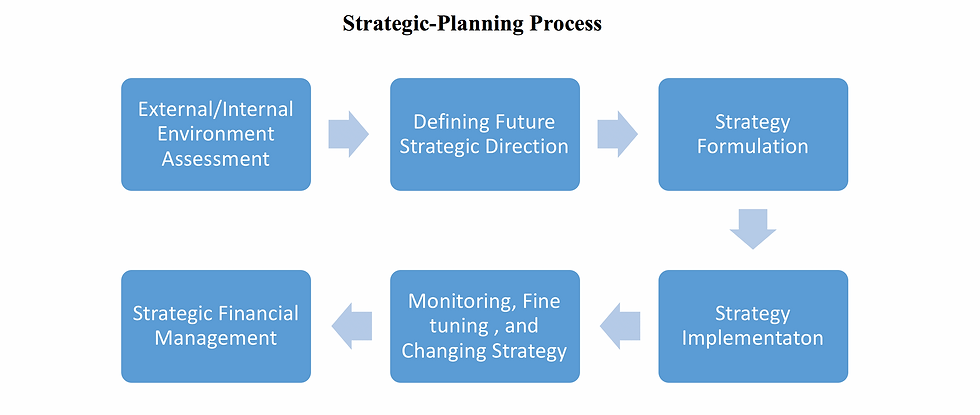
Benchmarks may follow a functional area strategic plan. In the strategic planning process displayed above baseline, elements were not shown. Benchmarking pave the way for the organization to compare organizational performance with industry standards. After the Benchmarks, come the strategic objectives.
According to Moseley (2009), "Strategic objective is long-term strategic thrusts that will bring an organization closer to realizing its vision." There has to be a way to measure the goal, To translate strategic objective to operational realities, (Moseley, 2009). There should also be a standard set for the aim to facilitate its effectiveness (Moseley, 2009). Mosley (2009) also delineates that there should be a deadline set to ascertain when to measure the objective. Finally, someone has been tasked with monitoring and achieving the goal (Moseley, 2009).Marketing initiatives have to align with strategic planning. Although alignment of marketing with strategy is essential, all efforts should be made to seek customer understanding and loyalty (Berkowitz, 2011).
Section Two: Strategy Planning Awareness
Weitzner & Darroch (2010), theorized that there is a correlation between enterprise risk management, ethics, strategic plans, and vital rationality risks limits. Thus, there is more to strategy-planning process and risk limits. Volatility and organizational politics characterize the strategic planning process. Healthcare executives will need to communicate, lead, and other abilities, to efficiently manage the complexities involved in the strategic planning process. Modern healthcare leaders should adapt to the dynamic environment as well as continue to fine tune the implemented strategy. By applying evidenced-based and systemic approach, the organization can efficiently and effectively manage the relationship and connections among various aspect of strategic planning. Relational marketing can help connect customers' needs and wants with the strategic planning process.
References
Berkowitz, E. N. (2011). Health care marketing (3rd ed.). Sudbury, MA: Jones and Bartlett.
Moseley, G. B. (2009). Managing health care business strategy. Sudbury, MA: Jones and Bartlett.
Weitzner, D., & Darroch, J. (2010). The limits of strategic rationality: Ethics, enterprise risk management, and governance. Journal of Business Ethics, 92(3), 361–372. Retrieved from:http://ezp.waldenulibrary.org/login?url=http://proquest.umi.com.ezp.waldenulibrary .org/pqdweb?did=1976776521&Fmt=6&clientId=70192&RQT=309&VName=PQD


Comments